
Hungary just held its parliamentary elections a week ago, on April 12, 2026.
It was the most consequential election in Hungary since the election of 2010. That was when Viktor Orbán’s Fidesz party won a landslide victory over the incumbent socialist party. It won again in 2014. And in 2018. And in 2022. What’s more, in each of these, Fidesz secured two-thirds supermajorities, enough to change the constitution. They used that privilege many times throughout those 16 years.
The vibes of the 2026 election felt different. The opposition Tisza party, led by Peter Magyar (his name literally translates to Peter The Hungarian), was more organised than previous opposition leaders, and had much more momentum behind it. It felt like this time, it was actually going to be a close call.
It was for this reason I decided to apply to be a vote counter (technically speaking: a member of the polling station commission - ‘szavazatszámláló bizottság’, or SzSzB).
I found the process of applying, preparing, and actually conducting the election as an SzSzB member fascinating. I also ended up finding out more about how the inner machinery of Hungarian democracy works.
Applying and preparing
There are two types of vote counters in Hungarian elections. Elected SzSzB members are chosen by the local municipal authorities, and delegated members are appointed by political parties. Each polling station should have both types of members.
I’m not a member or volunteer for any political party, so I applied to be an elected member. Applying was incredibly simple. Download a one-page form, fill in some personal information, tick some boxes, and email it to your local municipality’s dedicated email address. After a couple weeks, I received an email back that I had been elected.
Next, I was told by my local constituency office that I had to complete a remote learning course by the National Election Office (Nemzeti Választási Iroda). It started off with a dozen short animated YouTube videos, and then a more detailed, 100-page booklet that went through all of the rules we would have to follow and enforce. These were rules on things like setting up the voting booths, giving the ballots to the voters, and later counting the ballots. I’ve pasted the entire booklet below. It’s in Hungarian, but you can use your LLM of choice to get a sense of the rules.

Once I read it, I took the required multiple-choice online exam. I passed, and got a certificate, which I sent back to my point of contact at the local constituency office. The last step was to show up at the municipality mayor’s office, and swear an oath to respect the Hungarian constitution. With that, I was ready to show up on election day.
The mechanism design of vote counting
Before telling my story of how the election day went, I need to do a factual detour of how the voting system is designed in Hungarian polling stations.
Many call the Hungarian election system unfair. While that may be true, I found that the election system was definitely free. Free in the sense that there is no ballot-stuffing, “lost” ballots, misreported results, or other widespread electoral fraud. The critics of the system would say that the unfairness comes more from more macro factors, like gerrymandered voting districts, voter intimidation, and biased state media.
The Hungarian election system is resilient inside the polling station. For instance, as mentioned before, the SzSzB members are not appointed top-down by the National Election Office, but rather elected independently among local citizens by the local municipalities, with the possibility for parties to send their own delegates as well. Importantly, delegated members have identical rights and duties to elected members. They are able to participate in every decision, every count, and can individually file complains to the National Election Office if they suspect fraud or breaking of protocol, regardless of what the local committee majority decides.
There are other safeguards that fill the entire election handbook.
The local election office gives the SzSzB a large pack of clean ballots before election day. Every single ballot that the local election office provides must be accounted for. The same number must be sent back, whether those ballots are valid, unused, or spoiled.
The first civilian voter (not a committee member) inspects the urn to confirm that it is empty and that it is then correctly sealed with security plombs. They then sign the urn-sealing protocol sheet that records the security plomb serial numbers, which will be cross-checked when the urns are open after voting finishes. This creates a chain of custody that’s also attested by an ordinary citizen.
During voting, before a ballot is given to a voter, it must be stamped with an official seal in front of the voter. Pre-stamping is forbidden, and un-stamped ballots are considered invalid during counting. This prevents ballot stuffing, as without this rule, anyone with access to pre-stamped ballots could slip them into the urn.
The SzSzB works continuously from poll opening until all the votes are counted and recorded and all materials delivered to the election office. The SzSzB must be comprised of at least 5 members, and at least 3 must be present at the polling station at all times, where the urns are located. We were told that if, even for a second, there are fewer than 3 SzSzB members in the polling station, all votes in the urn could be declared invalid.
International observers can appear at any stage (before and during voting, or during counting) and without any prior notice. They can also inspect any electoral documents, ask questions, and raise concerns.
Mobile urns (aka mobile ballot boxes) are used for voters who are unable to make it to the polling station for health reasons, like being physically impaired or sick. When voting starts, the SzSzB members must all sign a ‘control sheet’ and place it in the mobile urn. After polls close, the SzSzB checks to make sure the control sheet is present in the mobile urn to ensure it is the same urn that left the polling station.
When taking mobile urns to voters, two SzSzB members delegated by the same party cannot take the urn together.
Members of the local election office can not be present at the polling station, except temporarily in case of need. This rule surprised me initially. The point was that state bureaucracy should not be able to sit in the room all day with the SzSzB (being the citizens’ body that actually makes decisions and does the counting, and is independent and subordinate only to the law). The only non-SzSzB member that stays in the room was the minute-keeper, who works for the local election office and helps by filling out the official forms that are then checked and signed by the SzSzB, but has no decision-making power.
The entire system is built on layered redundancy. No single person controls any critical step, every material decision by the SzSzB is documented (with copies), every count is verified at least twice, the committee is made up of municipality-chosen local citizens as well as delegates from several parties, members with non-aligned interests are present over the mobile urns, official state representatives have very little influence over the polling stations and vote counting procedures. At the polling-station level, I found the system to be really well designed, despite being completely paper-based.
Election day
I am not an early riser, so the fact that I had to show up at our polling station, a local primary school, at 5am was not quite the best part of this experience. I packed some iced coffee, water, and snacks, and took a brisk 10 minute walk from my house in Budapest to the polling station.
Polls open at 6am and close at 7pm, set so even someone who works a 12-hour-shift can find time to show up to the polls. We spent the hour we had before opening to arrange the tables, stick up signs, and to unpack and check the materials we were given by the local election office.
Our SzSzB had 7 members and we presided over a district of approximately 800 voters. Of the seven, the SzSzB had three elected members (including me), and four delegated members, of which two were from Fidesz, and two from Tisza. It was nice to have this many, as there was enough wiggle room for us to regularly take breaks and go out with the mobile urns without risking going below the minimum 3 threshold. There were about three people (including me) in their 20s, two in their 30s, and two in their 40s/50s. The president of the SzSzB, who practically has the same responsibilities as the rest of the SzSzB members with the exception that he has to do some additional admin work with the local election office in the days preceding the election, was a funny, energetic guy in his 30s who told us this was his 5th election as an SzSzB member. This put me at ease. I knew that even if I didn’t remember all the minutiae of every single rule and regulation in the handbook, there’d be an ‘adult in the room’ who I could turn to who knew what they were doing.
Once polls officially opened at 6am, we already had the first voter ready and waiting. He came in and we did the first-voter protocol with him, checking the urns to make sure they were empty, attaching the security plombs, and getting his signature to attest this. This wasn’t news to him however, as he mentioned how he’s on a first-voter streak for the third election in a row, something he took great pride in.
We were not allowed to use our phones while physically in the polling station, but could take them out if we stepped out of the room. This rule was meant to stop us being able to transmit information from the paper voter register, about who had voted and who hadn’t, to people on the outside.
Throughout the day, the atmosphere between us remained very lighthearted. We weren’t afraid to crack jokes even with voters in the room, even though we took our roles very seriously. I guess there was honestly not much more than banter that could occupy us during our 13 hour digital detox, especially when there was rarely a large queue of voters.
During voting, there are four real recurring ‘posts’ or ‘stations’ to be filled when you’re in the polling station as an SzSzB member, and honestly all of them get pretty boring very quickly.
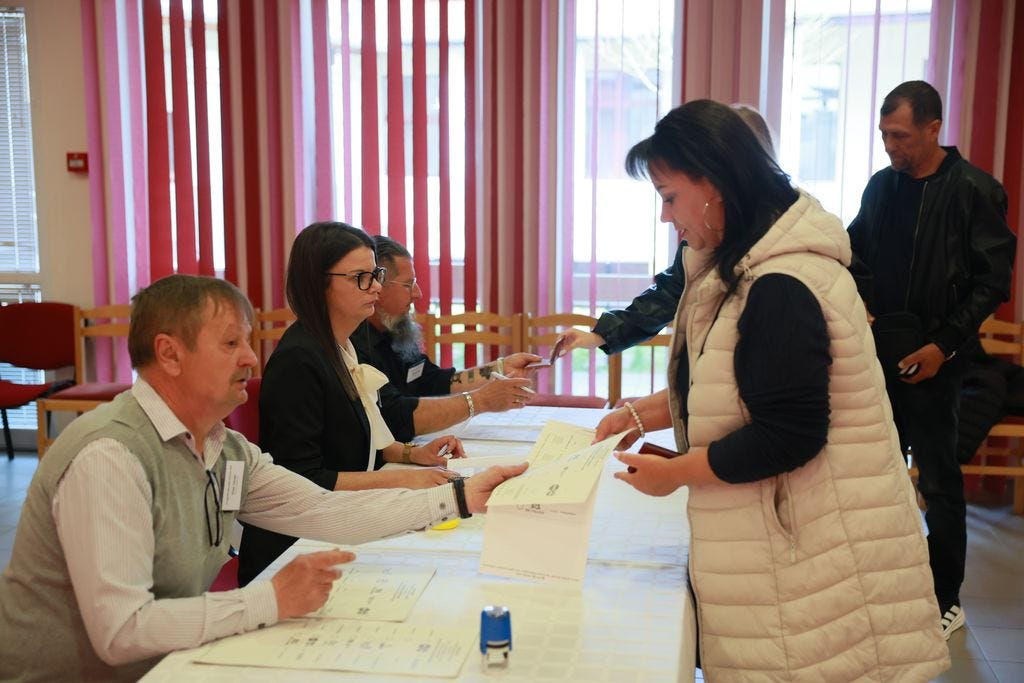
The first post is checking IDs. The voter comes to you, gives you their passport, ID, or drivers license, and you make sure it’s genuine, not expired, and they’re the ones on the picture. Even though it sounds dull, it actually was the most interesting relatively speaking of all the four posts, having the most human interaction. There were people whose IDs mentioned they were born in towns with interesting names like Sztálinváros (lit. Stalin-city), which turned out to be the old name for Dunaújváros (Danube New City). I also saw elderly people with very old paper-based IDs that made me feel like I was playing Papers, Please. The government that issued them at the time did not put an expiration date on them, so they were able to keep using them for decades afterwards.
The second post was, upon confirmation that the IDs were correct, to search up the voter on a paper-based local voter register, and ask them to sign next to their name. This post was usually the bottleneck time-wise among the four, and was the hardest. Hard not as in “quantum-physics” hard, but rather hard in that you had to avoid mixing up whether K comes before or after L in the alphabet and so forth.
The third post was tallying. Every time someone signs next to their name on the voter register, you mark a line on the tally sheet to keep a running count of voters. At set intervals throughout the day (7:00, 9:00, 11:00, 13:00, 15:00, 17:00, 18:30) the minute-keeper reports the count to the local election office, which is how the media announces “turnout at 13:00 was 37.98%” during the day. This post was pure clerical monotony, and was easily the most mind-numbing. Marking four vertical lines and then a fifth horizontal line crossing through them, in groups of five over and over again was about as exciting as it sounds.
The final post was ballot stamping and handover. Once the voter signed the voter register, the ballots were officially stamped in front of them and given to them, along with an envelope if they requested it. Any questions they had about the voting procedure would usually be clarified with them at this time.
The voter then went into the voting booth, drew an X for their party/candidate of choice, and came out with a ballot that they then dropped into the urn. Repeat 700 times.
I very quickly understood why the handbook had a recommendation that the roles among the SzSzB members should be regularly switched during the day.
Mobile Ballot Box Voting
By far the most interesting part of the experience was taking the mobile urn around the polling district to those who had requested mobile voting. I, along with a woman from the SzSzB, volunteered to go, and to my surprise no one else at the SzSzB was keen. We took the mobile urn voting register listing the voters we needed to visit, the ballot box that included the signed control sheet, a pen, pre-stamped ballots (ballots could be pre-stamped for mobile voting only), and hopped in her car and got going.
What I saw was surprising. We visited voters with a range of physical and cognitive conditions that made it impossible for them to get to the polling station. Many times we went into flats where the conditions were quite unpleasant. Some told us how long it had been since someone had actually visited them. It was all quite sad. I really respect the voting system for finding a way to allow these people to vote too.
Beyond being able to see a glimpse into the lives of a handful of local voters, it also gave us a chance to get some fresh air and have an hour or two to chat 1-1 with my fellow SzSzB member I was with. She had kids who she was worried for, and wanted to make sure the country was going in the right direction for them. Like me, it was also her first time in an SzSzB, and she had also signed up out of curiosity and a desire to take a more active role in what she also thought was the most consequential election in a long time.
Counting
When the clock struck 7pm, we closed the polling station, locked the doors, and took a collective sigh of relief knowing that we could move onto something new after the 13 hours of manning our posts. There was also a rule that besides the minute-keeper, no one was allowed to have a pen on them from this point on. Only pencils were allowed to make sure we couldn’t modify what were on the voters’ ballots (that were marked with pens).
After signing some official forms with the help of the minute-keeper, we rearranged the tables to provide space for the ballots, compared the serial numbers of the security plombs with the ones that we wrote down when polls opened, opened them, and dumped the contents onto the tables to start counting.
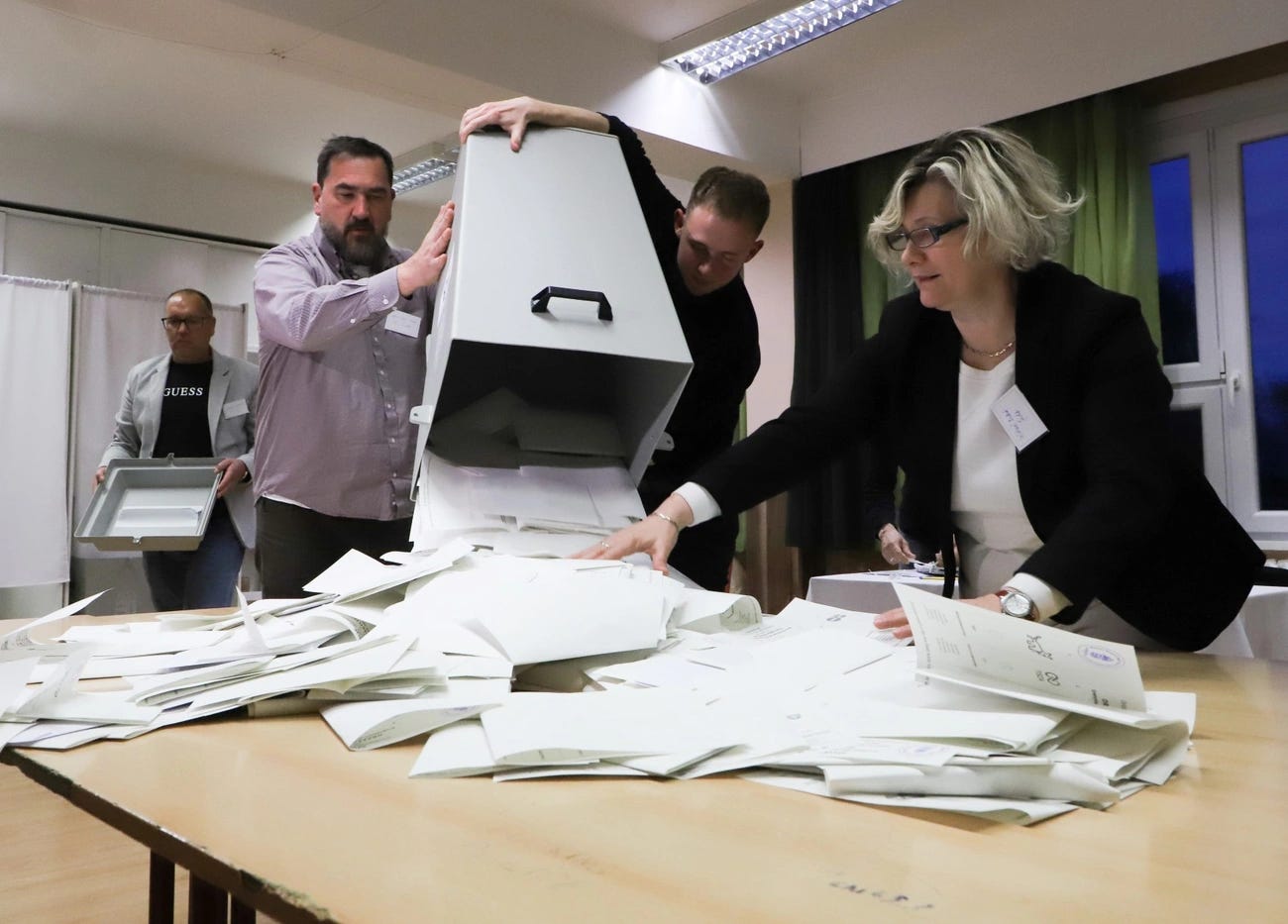
Now came the part which most people imagine when they think of being a vote counter. We took the ballots out of the envelopes (if the voter used one), and separated the ballots into the two types. The Hungarian election system is notoriously complicated, but to oversimplify, each voter gets two ballots, one for a selecting a country-wide party list (picture on the left) and another for selecting a single-member constituency candidate (picture on the right).
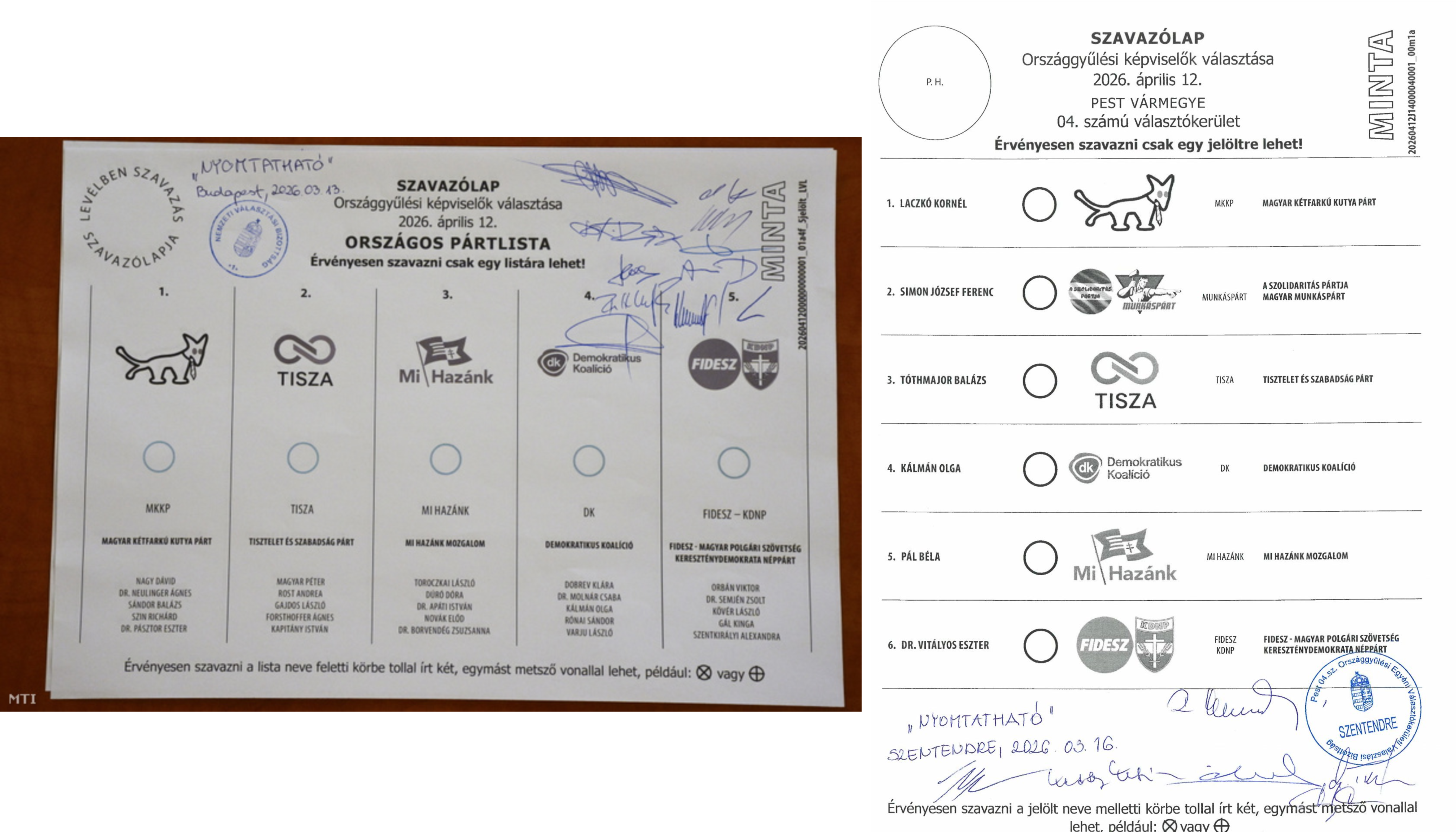
For each type of ballot, we separated the ballots again, this time by the party/candidate that received the vote, and double-checked that the ballots were correct (stamp present, X marked correctly, not more than one X on the ballot). We only had 3 spoiled ballots in our district, though sadly none of them wrote any funny messages on them. For each step, several independent people recounted and double-checked the work of other SzSzB members.
By the end of the process, our fingers were sandpapered down from all the ballots we had counted and recounted. It became clear that our polling district was among the top when it came to voter turnout, and the amount of votes for Tisza I saw on that table, even for a Budapest district, hinted that they were going to be in for a good night.
By about 9pm, 2 hours after the polls closed, we were all done, tired but elated. The minute-keeper packed the votes in the official boxes to be sent for safeguarding to the election office, we signed a couple more documents to certify the local district result, and I could go home. The president and vice-president of the SzSzB along with the minute-keeper had to then separately deliver the packets to the local election office in the evening, but at that point, that was above my pay-grade.
Thoughts
Was being an SzSzB member fun? Yeah, kind of. Going around with the mobile ballot-box was eye-opening. Learning about the rules in the week prior to the election was fun and reminded me of my Ethereum core researcher days. The actual post rotation at the polling station was less so. It is after 60 minutes of sitting in a chair in a stuffy primary-school room, recording horizontal lines for the vote-counting tally after each voter signature that you start to let your mind wander into a more contemplative state. I began to wonder… would it not be easier to have this all done digitally? Well maybe, but paper voting means attacks are harder to scale. Although Estonia seems to do a pretty good job I guess? Surely we could just copy them? Or how about the mechanism design of this? What is the maximum number of malicious SzSzB members the system could handle before it's vulnerable to electoral fraud?
Was I glad I did it? Yes, for sure. It was a sort of experience that was very self-contained, an hour or two of admin, then a 15 hour marathon on election day sacrificed for the greater good and I was done.
For me, a large part of the concrete enjoyment was the ‘people watching’ aspect, sitting down somewhere for an entire day watching an entire cross-section of society show up for five minutes each at our polling station. There were parents walking in with their curious kids, teaching them about democracy. Guys who I could swear had massive hangovers, maybe still a bit tipsy. Cute dogs sniffing around while their owners were in the voting booth. Very ecstatic young voters who just turned 18 with their faces gleaming about being able to vote for the first time. Elderly couples dressed up for a fancy occasion spontaneously recounting to us about what their lives were like decades ago. The security guard of the school-temporarily-turned-polling-station proudly watching the entrance of the school to make sure there was no disorder, occasionally chatting to us when we went out for a break. In many ways it was a sort of anthropological experience more than anything, something you don’t really take the time for while you’re locked in on the daily grind.
There is also a sense in which it’s a job you find fun not because of the concrete tasks you complete during the day, but rather more in the vague abstract sense of completing some sort of ‘civic duty’ or ‘supporting democracy’ or something like that, something that you can tell your dad or uncle or cousin at the dinner table and hope they’ll be proud of you in a way that is more concrete and believable than telling them you’re the founder of a startup that does XYZ with important customers like ABC that I swear are really huge names but no you wouldn’t have heard of them because you’re not in the industry.
After I started my 10 minute walk home from the polling station at 9pm, it was as dark out as it had been when I woke up that morning. I put my AirPods in and tuned into an election live-stream. Within minutes, it was announced that Viktor Orbán had conceded. By midnight, over 98% of the votes were counted. Ten thousand stuffy rooms just like ours, each with their own tally sheets and security plombs and bored members rotating through the same four posts had produced a result that will define Hungary’s future for the next 4 years. The country knew its answer.