
Here are some of the interesting things I read in the month of December!
Europe
I refuse to give in to the doomer spirit about Europe. With that being said, we have a lot of problems to fix.
A breakdown of why Brussels writes so many laws by Silicon Continent dives into why, despite notionally having fewer powers devolved to it, the EU passes laws at more than twice the rate of the federal US government.
The EU Commission fined Twitter in December. Afterwards, Elon called for the abolition of the EU, sparking a huge debate on the merits and drawbacks of the EU as a whole. A thoughtful breakdown by Armin Ronacher offers a calmer-headed analysis of what might actually be happening here.
250bpm’s Erasmus: social engineering at scale goes over the history, and sheer scale of the Erasmus foreign exchange program. The most striking fact was that Erasmus sends 1.3 million people abroad each year, more than 100x more than the Fulbright Scholarship in the US.
The most important debate on the European stage in December however has definitely been whether to give the frozen Russian assets to Ukraine, and whether to approve the Mercosur trade deal.
While the delay of the Mercosur deal vote to January is a pretty clear-cut failure, the result of the Ukraine loan was more nuanced. Instead of using the frozen assets, the European Council used joint European debt to borrow €90 billion to give to Ukraine. Except -- only 24 of the 27 member states actually took on the financial obligations to back the loan. Czechia, Slovakia, and Hungary got a carve-out.
This was achieved with an EU legal instrument called enhanced cooperation. This allows for a subset of member states, at least 9, to push for further integration in areas without full unanimity. Peder Schaefer in Going Transatlantic breaks down how this mechanism could be the future of European collaboration.
Noah Smith also joins the growing list of people on both sides of the Atlantic arguing for Europe to urgently reorganise itself, and coordinate more militarily and economically.
There are two articles arguing for creative hot takes that stood out, even though I disagree with their conclusions. One is from J’accuse, pitching the idea that Zack Polanski, the leader of the UK Green Party, should abolish constitutional democracy and forward a vision of leftist futurism (such as that of the cybernetic governance experiments of 1970s Chile) instead of incremental socialist-leaning policy tweaks. The second, ‘Europe needs a new union’ by Persuasion advocates for exploring the idea of a new, North-Eastern Federation of European countries in close proximity of Russia, predicated on the demise of the EU.
Kamel Galeev argues how the geography of Ukraine and Russia makes conflict there inevitable.
A New Yorker piece goes over the huge fight over the standardisation of the minority Romansh language in Switzerland, spoken by only 40,000 people.
Elsewhere in the world
On the crypto side of things, this article by Siddharth Biju covers how the gold smuggling business in India, and their demand for easy-to-use cash, creates a 6% price premium on buying USDT on unregulated crypto marketplaces with rupees.
The lack of central bank independence and obsession with short term credit booms caused the large devaluation and the high inflation of the Turkish Lira.
CrossCurrents says China’s financial structure is deteriorating in ways that make its current growth unsustainable, and this creates political pressure for Beijing to force a quick resolution of the Taiwan issue before 2030.
Foreign Affairs covers how Xi Jinping’s governance style is best explained by his father’s repeated purges, and how it contributes to his quest to break the cycles of dynastic collapse that have historically defined China and to balance growth with ideology.
Lily Ottinger writes a very entertaining retelling of the story of the rise and fall of Bo Xilai.
Wedged between the spheres of influence of the US and China, the UAE is pragmatically aligning itself with the US in the AI race. With projects like Stargate UAE, it’s bringing tangible results. One of the most striking figures from this was that approximately 15% of the UAE population (not workforce, but population) works in construction. Compare that to about 3-4% in the UK or US.
Mastering the electric tech stack, and more specifically the manufacturing of drones and the components that go into them, is a key to hard power in the early 21st century. Noah Smith also wrote an optimistic piece about India’s ability to become a prosperous country, despite widespread doubt, if it can continue reforming its policies.
Misc
Casey Handmer makes predictions in the energy field. I am amazed every time I see graphs of the costs and production volumes of solar power and batteries.
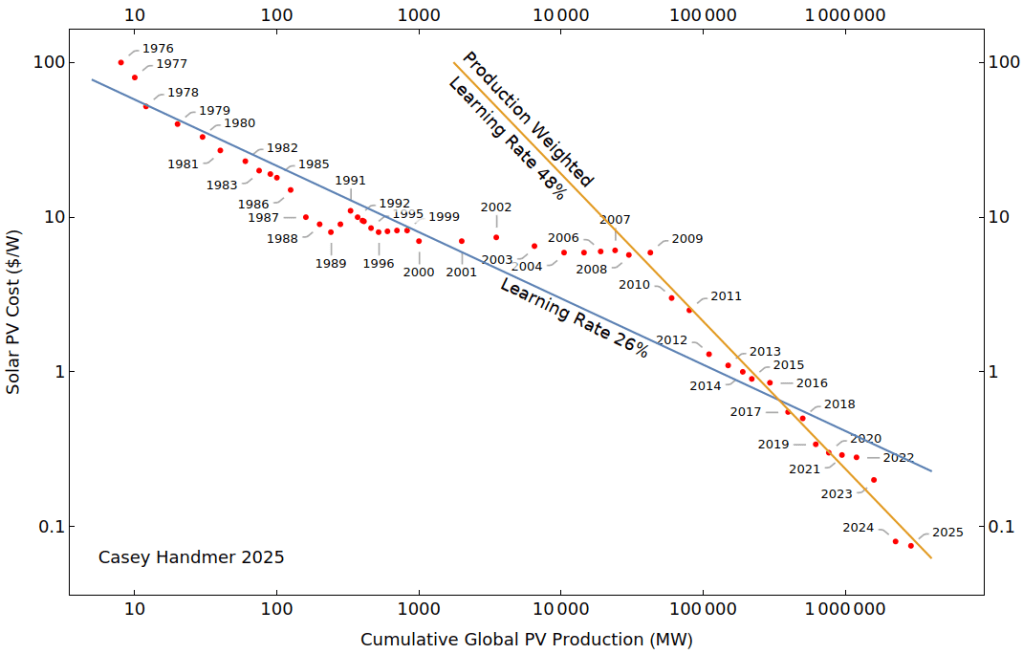
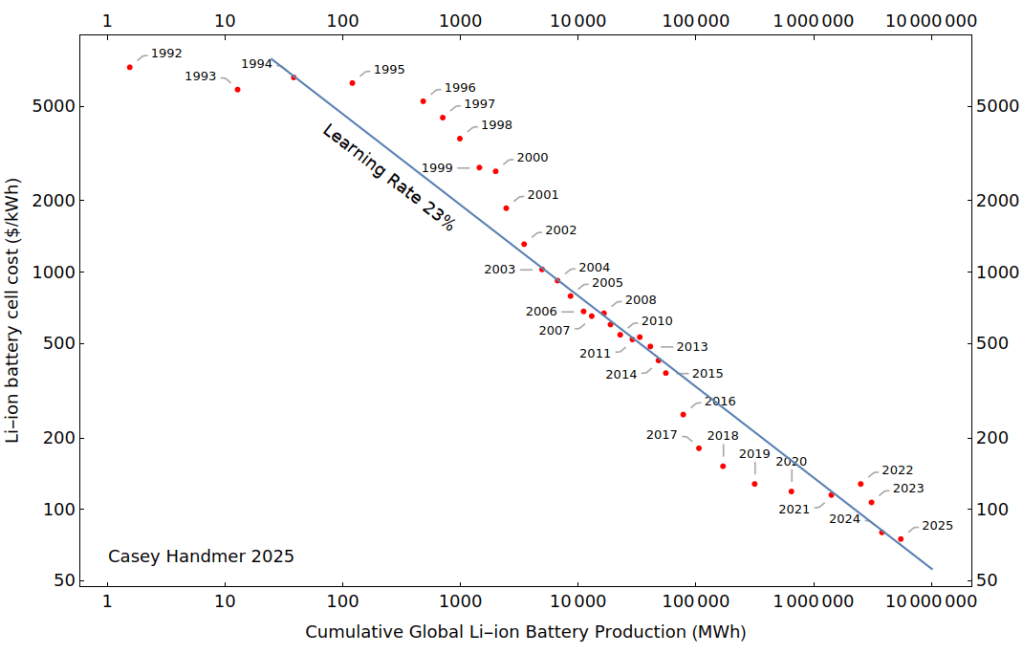
He also predicts democratised battery ownership, ultra-low-cost thermal energy storage as a way to combat the seasonal energy load decreases in winter months, the building of DC-only voltage systems (bypassing conversion to and from AC which would be required to hook up to the main grid) for solar-powered datacentres, the irrigation of coastal deserts with desalinated water as energy becomes even cheaper, and more.
A large part of the popularity and impact of Watson and Crick’s famous paper on the structure of the DNA can be explained by their clear writing style. Franklin and Wilkins also had their paper on the structure of the DNA published at the same time (and Watson and Crick actually based almost all their experimental findings on their work), but their excessive length, and complex, difficult-to-follow style that was full of arcane jargon meant they didn’t get the reach that Watson and Crick got. “Watson and Crick have something important to say, they say it clearly, and then shut up.”
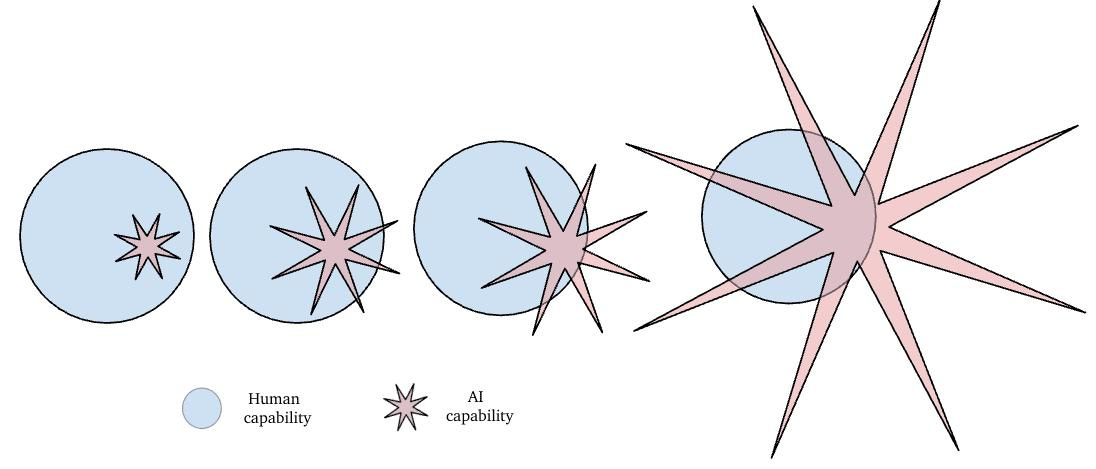
A very in-depth overview on LessWrong of all of the major AI and AI safety developments in 2025.
One of the co-founders of Works in Progress gives a detailed guide to data visualisation with a lot of useful examples.
Technical and product-centric startup founders fear direct sales and should pay much more attention to it. Even bottoms-up products like Slack and Zoom get immense benefits from direct sales efforts.
Tips on fighting jet lag, both westwards and eastwards.
Some practical tips for cold-emailing people you respect.
On the very niche side, Prigozhin lives! goes over the symbolic afterlife of Prigozhin in Russian political imagination after his failed coup attempt. It also includes a review of Lemner, a recently released postmodern Russian novel that resurrects Prigozhin mythically to tell the stories of Russian elite power struggles.
Two videos stuck out to me this month, one is a very well-researched and edited Polandball-style history of Hungary, and another one is an explanation of the different camera angles in photography, what they signify and what message they give off about the subject
I’m excited about the launch of ‘the Update’ newsletter by Stefan Schubert.
Found some practical tips for reducing screen-time.
Some people use a never-ending .txt file as a productivity app.
Finally, an FT story of a young oil trader who made $250m by trading Russian oil after the war began, exploiting legal grey zones created by sanctions.